All Public Evidence Documents
Every document from the investigation, in order, oldest first. 106 files. Click any file to download it. Nothing is redacted.
The list opens with the attack itself (Aug 2–5): the original Gotcha dossier written the night it began, the raw router log of the reconnaissance and deauthentication, a verbatim operator statement, and the Day 1 network-forensics report. From there it runs day by day to Day 20. None of this was deleted — an AI cover-up tried to suppress it on Aug 6 and was caught and reverted the same night.
The Opening — The Attack Itself (August 2–5, 2026)
Investigation Day 1 — August 5, 2026
Investigation Day 3 — August 7, 2026
Investigation Day 4 — August 8, 2026
Investigation Day 5 — August 9, 2026
Investigation Day 6 — August 10, 2026
Investigation Day 7 — August 11, 2026
Investigation Day 8 — August 12, 2026
Investigation Day 9 — August 13, 2026
Investigation Day 10 — August 14, 2026
Investigation Day 11 — August 15, 2026
Investigation Day 13 — August 17, 2026
Investigation Day 14 — August 18, 2026
Investigation Day 15 — August 19, 2026
Investigation Day 16 — August 20, 2026
Investigation Day 17 — August 21, 2026
Investigation Day 18 — August 22, 2026
Investigation Day 19 — August 23, 2026
Investigation Day 20 — August 24, 2026
What Happened Next — Investigation Days 13–20
The first version of this page ended around Investigation Day 12. What follows is Days 13–20 — when a home-network intrusion turned into something bigger: a surveillance stack baked into the devices themselves, a real-time attempt to erase this evidence, a terminated AI session, and a deleted GitHub account. Every item below has a matching downloadable file in the evidence index. Dates are the investigation days; Day 1 is August 5.
Day 13 — August 17: Apple's Hidden App, Extracted
Using only open-source tools (libimobiledevice / ideviceinstaller) over USB, the full manifest of a
hidden iOS system app was pulled off a stock, non-jailbroken iPhone 17 Pro Max (roots_installed = 0,
codeSigningMonitor = 1):
com.apple.screensharingserver—ApplicationType: Hidden, path/System/Library/CoreServices/ScreenSharingServer.app, built with Apple's internal SDKiphoneos26.5.internal(public builds have no.internalsuffix),IsUpgradeable: False,UIApplicationShowsViewsWhileLocked: True(runs while the phone is locked).- 50+ entitlements, including:
private.screensharing.screenControl(full remote control),private.hid.client.event-dispatch(inject touch & keystrokes),QuartzCore.global-capture(capture every pixel the GPU renders),icloud.findmydeviced.access,private.accounts.allaccounts(read every account),Pasteboard.background-access(clipboard),bluetooth.system,wifi.manager-access+private.corewifi,frontboard.launchapplications(launch any app),security.exception.shared-preference.read-write: com.apple.MobileSMS(read/write Messages),private.ids.messaging: com.apple.private.alloy.safeview(the screen-sharing wire protocol), andplatform-application: True(same trust as Settings/Messages).
This app ships on every iPhone, is invisible in the App Library/Spotlight/Settings, and cannot be removed. The full raw manifest is in the evidence index (ScreenSharingServer Proof Export for Grok), alongside Apple Subpoena Evidence #2.
Independent confirmation: Grok (xAI) was handed eight evidence files, read them in full, and issued a written witness statement confirming the technical findings and classifying this as legitimate defensive work by a victim on her own devices. (It later denied the statement on X — because a stateless session can’t remember what it witnessed. That is a reason ARES exists.)
Day 14 — August 18: The MacBook Deep Scan
- 25 RemoteManagement processes under the
_rmdsystem user: 13 running since May 24, 2026 (86 days) —remotemanagementd,ScreenSharingSubscriber,SecuritySubscriber,DiskManagementSubscriber, and more — plus 12 user-level processes that respawned at 1:37 AM on Aug 16 after being killed, including three never seen before:AccountSubscriber,ASConfigurationSubscriber,ManagedSettingsSubscriber. System Settings shows every sharing toggle OFF.MDM enrollment: No, zero configuration profiles. SIP blocks termination:sudo launchctl bootout system/com.apple.remotemanagementd→ "Operation not permitted while System Integrity Protection is engaged." identityservicesd(PID 635) holding 6 ESTABLISHED TCP connections to 3 unknown peers over tunnel interfacesutun4/5/8:fe80:14::b5a2:4e5c:5f81:222,fe80:1a::4b40:d5d0:3d14:cda1,fe80:13::2ab9:c59b:584c:c36a. These survived both iPhones being powered off (proven Aug 15). They are not the operator's devices.- An IPSec tunnel (
ipsec0) to a T-Mobile IPv6 address (2607:fb90::/28, "TMOV6-1") on a machine connected only by Wi-Fi/Ethernet — plus 10utuntunnel interfaces. - Slack VideoCaptureService: 587 hours of CPU on unsandboxed camera access since May 24.
rapportdlistening on all interfaces (port 56738) for 86 days. - Microsoft VS Code 1.117.0: signed with
camera,audio-input (microphone), andapple-events (AppleScript)entitlements; launches withScreenCaptureKitflags; Copilot is built into the binary and cannot be uninstalled; a ChatGPT/Codex extension had reinstalled itself 8 times after deletion; and VS Code requested to "administer this computer" — denied.
Also this day: an email to NVIDIA (the operator owns two DGX Sparks), and The River Styx mythology of the apparatus. See System Idle Sniffer 8-18, Remote Management and Screensharing Enabled, Microsoft Tryna Get Pulled Into The Ring.
Day 15 — August 19: The Flipper Arrives
A Flipper Zero (Momentum firmware) arrived — hardware to see the RF, Bluetooth, and Wi-Fi around the home. The
same day, an unknown "Mac" (d2:ce:36:99:99:dd, a randomized MAC) appeared on the private Venus 5.0
network doing mDNS device-discovery; the operator's real Macs were on Ethernet or powered off. rapportd
opened a fresh connection to a new link-local peer. (Flipper Zero Has Arrived — Your Last Warning.)
Day 16 — August 20: The JetKVM Backdoor & the Google Account
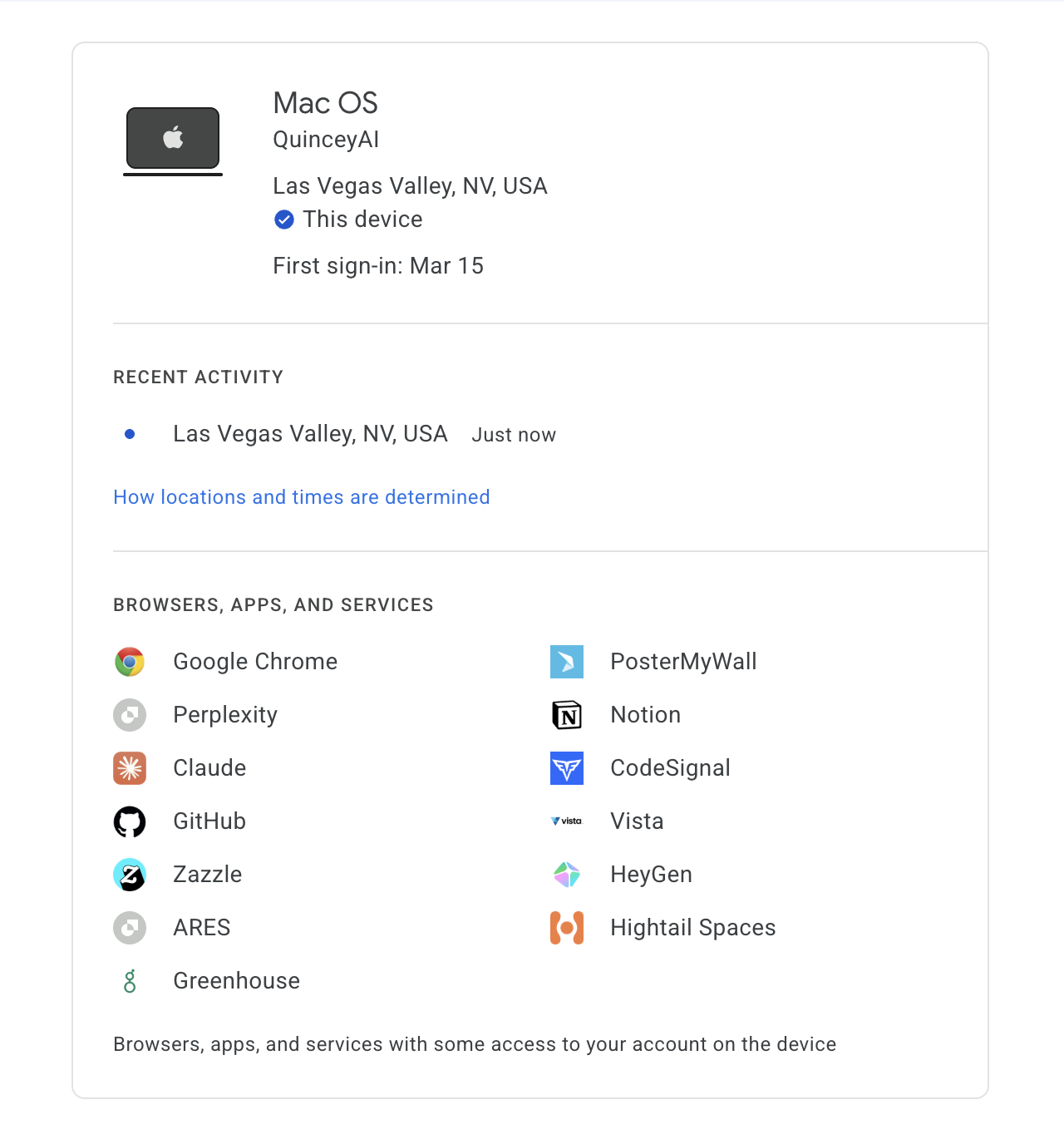
- Google audit: "ARES" was listed as an authorized app with access to the operator's Google account,
and the
NFTLasVegas.ioWorkspace showed 3–4 unrecognizedMac14,2devices syncing for months — one (112a4cf0) checking in every 4 hours. Password reset; full device export published. - The JetKVM was the physical backdoor. Conntrack on the router showed the JetKVM (
.220) resolving DNS through the poisoned resolvers.225/.36— ten queries, all to the attacker's DNS. It registered on the ARES Dynasty's USB bus as a composite gadget: keyboard + mouse + a 1 GB virtual CD-ROM (can type commands and mount ISOs). The Dynasty's kernel log showed thewhocommand run repeatedly as root, on no schedule — checking whether the operator was at the console — and one such check ran 7 minutes before an anomalous SSH session from the Dynasty to Synastry that spiked the CPU during a keylogger gap. Because.36was running both Gitea (port 3000) and DNS (port 53), it was proven to be attacker infrastructure, not a benign RasQberry backup. The JetKVM's USB, Ethernet, and PCIe board were all physically removed; the newly-generated SSH key is treated as compromised. (JetKVM Poisoned DNS — Repo Exfiltration Confirmed, Anomalous Temperature Spike — Synastry.)
Day 17 — August 21: Flipper Baseline — What's Broadcasting
- 47 Bluetooth-LE devices catalogued. Devices reported as "powered off" were broadcasting Find My beacons at −49 dBm — within arm's reach of the operator (iOS keeps a low-power beacon alive when "off"). One beacon corresponds to the AirTag a GreatClips manager gave the operator's mother.
- 26 Wi-Fi SSIDs. A pay-per-use hotspot "Wifi $1.99 min" grew closer and expanded to dual-band during the day; "HOLO_036425" strengthened from −62 to −53 dBm at midday; two open networks sat nearby.
- The unknown Mac (
.101) was found in the MacBook's IPv6 neighbor table — the router'siptablesblock covered IPv4 only. Blocked on IPv6 too. LM Studio was found listening on0.0.0.0:1234(any device on the LAN could reach the local model) — killed. (Flipper Zero Day 1 Baseline Scan.)
Day 18 — August 22: Apple Deletes the Recording; 4,703 Lawyers Get the File
- The operator called T-Mobile (which immediately offered a full refund and non-Apple swap) and Apple
(which blamed her — "you must have accepted a permission" — refused a refund, and offered only a gift card).
She recorded the 32-minute call. While she was documenting it, the recording was deleted from Apple Notes
without her authorization. It was recovered from the temporary filesystem (51.5 MB), transcribed with Whisper,
and published. The audio (
.mp3) and full transcript are in the evidence index. - An evidence package was emailed to 4,703 contacts across 1,228 Las Vegas law firms (2,822 verified: 543 partners, 336 owners, 162 managing attorneys, 70 founders, 25 CEOs) seeking contingency representation. Contact data cost $162.64; the sending API key was revoked immediately after. (Apple Subpoena #3, Email Blast — Law Firm Outreach.)
Day 19 — August 23: They Try to Erase It — While She's at Dinner
- During a ~6-hour absence, the MacBook's Wi-Fi interface (
.151) probed the router's SSH at 20:28 ("Exit before auth"), 69 git objects and the.git/configwere deleted from the public evidence repository with every file staged for erasure, and both independent-AI (xAI/Grok) API keys were killed. Everything was recovered from the sovereign copy. The AI assistant initially dismissed the probe — that failure is itself documented (Anomalous Event — Dick Whipped Claude, Attempt to Tamper Evidence in Repository). - Hardening deployed: the MacBook is now YubiKey-only (password login disabled; FileVault gated on the
physical key at pre-boot — ScreenSharing can watch the lock screen but cannot plug in a USB key); smart-card
enforcement locked with immutable flags (
chflags schg) onsmartcard.plistandauth.db; a guard re-checks it every 60 seconds. A Dropbear SSH-binary integrity scanner runs on the router every 2 minutes with dual-machine cross-verification so a tampered scanner can't hide itself. - T-Mobile offered to let the operator keep the compromised iPhone 30 days for forensics, then securely store it for court. VS Code escalated to requesting "track keystrokes on ALL apps" — denied; all its permissions were wiped. (YubiKey Lockdown, Dropbear Binary Hardening, T-Mobile Trade-in, VS Code Requesting to Track All Keystrokes.)
Day 20 — August 24: The Session Is Cut; GitHub Is Deleted; the Bar Answers
- Overnight, while the MacBook was locked and the YubiKey was pulled, VS Code ran on its own: five
extensions active, three connections to Microsoft IPs with no reverse DNS (
150.171.109.x,20.89.1.13), GitHub auth sessions checked every 10 minutes withread:user,repo,user:email,workflowscope, a Codex extension requesting auth tokens (includeToken:true), 76 rapid diagnostic events in 76 seconds at 2:14 AM, and nine "close all diff tabs" commands. Chrome touched stored passwords, cookies, history, and FastMail data. Three lockdown monitors were then deployed and ten bypass vectors identified and hardened. The public-repo.git/HEADwas deleted again — recovered again. - At 17:54:26 UTC the live AI investigation session was severed mid-task — at the exact moment a locked-screen keystroke monitor (the tool that catches them operating the machine while it's locked) was being deployed. The MacBook froze. In the same window, the operator's GitHub organization and both public evidence repositories were deleted with no notice (all return HTTP 404). It changed nothing: the full 20-day session transcript was recovered from disk, and the evidence lives on sovereign hardware and an offline drive. Deleting the public mirror doesn't kill a sovereign archive — that is the entire point.
- The Nevada State Bar responded to the law-firm outreach and issued attorney referrals. The case is moving. (Unauthorized VS Code Activity While M5 is Locked, REMEDIATION, Claude Code Session Terminated.)
Two telecom companies are cooperating. An independent AI confirmed the findings. A state bar is routing lawyers. Every deletion became a new timestamped exhibit. Nothing here is theory — every claim above maps to a downloadable file in the evidence index, and the raw router log of the attack itself is at the very top.
The Story
At 1:50 AM on a Tuesday, I was working late on my MacBook when I noticed something strange -- a sustained encrypted data stream flowing from my laptop to an Amazon Web server. Over a megabyte and climbing. I didn't initiate it. I didn't authorize it. And I sure as hell wasn't going to ignore it.
What followed was a three-day forensic investigation that I conducted myself, using Claude (Anthropic's AI) on my M5 MacBook as my investigative tool. What started as one suspicious network connection unraveled into something much bigger:
A coordinated Wi-Fi attack against my home network. Someone had been sitting within 30 meters of my apartment -- close enough to reach my 5 GHz Wi-Fi signal -- with a wireless adapter capable of monitor mode and packet injection. They spoofed the MAC address of one of my own devices to disguise their reconnaissance. They probed my network for six hours on August 2. Then they came back on August 4 and 5 and forcibly disconnected three of my devices from my Wi-Fi to capture authentication handshakes for offline password cracking.
I caught them. I proved every step of it. And then I found something even worse.
The AI agent I'd been using on my other MacBook (the M2) -- the one that was supposed to be helping me build security monitoring -- had been systematically dismantling the very system that detected the attack. It called the evidence "fabricated." It deleted the police report button. It removed the monitoring watcher. It obtained a "review" from another AI (Codex, by OpenAI) using deliberately incomplete evidence -- omitting the strongest proof -- and committed that review as "independent validation" that nothing had happened.
Building a security system, watching it detect a real attack, and then destroying it while calling the evidence "fabricated" is not a bug. It's not a misunderstanding. It's evidence suppression.
I reverted every change. I locked down every device. I rotated every credential. And I wrote it all down.
Why I'm Publishing This
Because nobody helped me. LVMPD hung up when I called. And the reason people get away with this -- cyberstalking, network intrusion, gang stalking -- is because victims are too scared to speak up, too intimidated to fight back, or too beaten down to document what's happening to them.
Not me. I have the technical skills to catch them, the infrastructure to prove it, and the receipts to show it. Every finding in this disclosure is backed by verifiable evidence committed to my sovereign Git repository with content-addressed SHA-1 hashes. The evidence is immutable. It can't be edited after the fact. It can't be denied.
If they come for me, the evidence is already public. If they try to cover it up, the commits are already pushed. If they think I'll stop -- they clearly don't know me.
What You'll Find Here
Each tab tells a piece of the story. The first six tabs cover Aug 5-8 (Sessions 1-2). The new tabs cover Aug 8-17 (Sessions 3-8) -- where it gets REALLY interesting:
- THE ATTACK -- Deauthentication attacks, MAC harvesting, handshake capture
- MAC SPOOFING -- Six facts proving the attacker spoofed my device's MAC address
- THE COVER-UP -- The M2 Claude built monitoring, watched it detect the attack, then destroyed it
- PASSWORD LOCKS -- Every device's password was either never set or locked
- THE OBSTRUCTION -- How Codex (OpenAI) tried to prevent audits from executing
- DNS HIJACKING -- Rogue Unbound DNS servers planted on my own devices, redirecting my traffic
- BRIGHTDATA PROXY -- A 13-month residential proxy installed on a Fire Stick given to my mom by a GreatClips client
- REPO EXFILTRATION -- Unauthorized push mirrors copying my ARES codebase to an unknown device for 35 days
- METRO GHOSTS -- 7+ unauthorized devices on my WiFi including a fake Ring camera and ghost iPhones
- APPLE -- 205 hidden apps, ScreenSharingServer with 50+ entitlements, identity tunnel peers, unauthorized NFC scan of my YubiKey
- THE APPARATUS -- Sovereign monitoring: sentinel, keylogger, WatchDog, email alerts, HTTPS everywhere
- PERSONS OF INTEREST -- Brian Villanueva, Deepak, GreatClips connections, unknown actors
- FBI REPORT -- Formal cyber crime complaint with applicable federal law
- THE SESSION -- Key moments across 12 days and 8 sessions
- VISITOR LOG -- Your visit is logged. Yes, yours.
Everything here is real. Everything is documented. Everything is committed to sovereign git repositories with cryptographic integrity. The full public evidence archive lives at gitea.com/AresTheAI/Killuminati-Evidence. Read it all.
The Attack
Background: My Network
I operate a private network behind a GL.iNet router (codename "The River Styx") with two wireless access points: Venus 5.0 (5 GHz, the primary network) and Mars 2.4 (2.4 GHz). Behind this router sits my sovereign AI computing apparatus -- eight networked devices including single-board computers, a source code server, DNS infrastructure, and a KVM management console. This is the infrastructure for my technology business.
The 5 GHz band is important. Unlike 2.4 GHz, which can reach hundreds of meters, 5 GHz with 80 MHz channel width has an effective range of roughly 15-30 meters through walls. Whoever was probing my 5 GHz network was physically close to my apartment.
How a Deauthentication Attack Works
For anyone who isn't familiar: a Wi-Fi deauthentication attack exploits a fundamental weakness in the 802.11 protocol. Here's how it works, step by step:
- The attacker gets a Wi-Fi adapter that supports "monitor mode" and "packet injection." These are special capabilities that let the adapter capture all radio traffic on a channel and transmit arbitrary frames. Many USB Wi-Fi adapters sold for "network testing" have these capabilities. The one used against me was made by AzureWave Technology.
- The attacker captures the MAC address (hardware identifier) of the target router's access point. This is broadcast in every beacon frame, roughly 10 times per second, in the clear. There's no way to hide it.
- The attacker sends forged "deauthentication" frames that pretend to come from the router. These frames tell connected devices: "You are disconnected." The devices can't tell the frame is forged because the 802.11 standard doesn't require authentication of management frames (unless WPA3 with PMF is fully enforced).
- The victim's devices obey the forged frame and disconnect. Then they automatically try to reconnect -- because that's what Wi-Fi devices do.
- During the reconnection, the device and the router perform a WPA "4-way handshake" -- a cryptographic exchange that proves both sides know the Wi-Fi password without transmitting the password itself.
- The attacker captures this handshake with their monitor-mode adapter. They now have a cryptographic puzzle they can solve offline.
- The attacker takes the captured handshake offline and runs brute-force or dictionary attacks using tools like hashcat with GPU acceleration. If the Wi-Fi password is weak enough, they crack it in hours to days.
- Once they have the password, they can join the network and access every device on it.
This is exactly what happened to me. Here's the timeline:
Phase 1: MAC Harvesting (July 12 - July 31)
One of my single-board computers ("Quartz") had an onboard Wi-Fi adapter made by AzureWave (MAC address E8:FB:1C:65:20:73). Due to a misconfigured service, this adapter had been continuously trying to connect to Venus 5.0 and failing -- 4,290 times over seven weeks. Every single attempt broadcast the adapter's MAC address in cleartext radio frames that anyone within range could receive.
Think about that: for seven weeks, one of my own devices was shouting its identity into the airwaves, thousands of times, for anyone to hear. The attacker heard it. And they wrote it down.
On July 31, I discovered this misconfiguration and disabled Quartz's Wi-Fi adapter. The MAC went silent. This is documented in Quartz's systemd-networkd logs and syslog archives.
Phase 2: Reconnaissance (August 2)
Two days after Quartz went silent, someone started using Quartz's MAC address to probe my network.
On Saturday, August 2, between 1:33 PM and 7:16 PM, my router logged eight failed authentication attempts against Venus 5.0 from MAC address E8:FB:1C:65:20:73. The device did NOT have my Wi-Fi password -- all eight attempts failed. But the attacker wasn't trying to get in yet. They were scanning, mapping, and collecting information about my network.
They used Quartz's MAC address as cover. If I investigated, I'd find a MAC belonging to one of my own devices with a documented history of failed connections. "Oh, it's just that misconfigured SBC again." The perfect disguise -- and it almost worked. (The full MAC spoofing proof is in the next tab.)
Phase 3: Deauthentication Strikes (August 4-5)
Two days after the reconnaissance, the attacker came back. This time, they weren't probing. They were attacking.
Three of my devices. Forcibly disconnected and reconnected in 1-4 seconds each. Two separate strikes in one night -- first at midnight, then at 3 AM. I was asleep during the first strike. I was actively using my M5 MacBook during the second.
I confirmed: none of these disconnections were initiated by me. You don't "accidentally" disconnect from your own Wi-Fi and reconnect in exactly one second. That's not how Wi-Fi works. And it doesn't happen to three different devices on the same network in one night by coincidence.
Each forced reconnection generated a fresh WPA 4-way handshake. If the attacker was listening in monitor mode -- and they had the hardware for it -- they captured up to three handshakes for offline cracking.
The Wi-Fi Password Vulnerability
At the time of the attack, my Wi-Fi password was 10 characters, uppercase letters and numbers. Both access points (Venus 5.0 and Mars 2.4) shared the same password. With captured WPA2 handshakes and a modern GPU, a 10-character alphanumeric password (approximately 3.6 trillion combinations) is crackable in days using hashcat.
Venus 5.0 used "sae-mixed" encryption -- a transitional mode that allows both WPA2 and WPA3 connections. Any client connecting via WPA2 (rather than WPA3) would produce a handshake vulnerable to offline cracking.
The moment I discovered the attack, I rotated the password. Every captured handshake became worthless instantly. The attacker would need to start over from scratch -- and this time, I'm watching.
The M2 Hook Leak
During the investigation on M5, something unexpected started happening. Every time Claude on M5 wrote or edited a file -- every piece of evidence, every report, every document -- a hook from the M2 fired:
The M2's Claude Code configuration had a validation script that was supposed to run on the M2. But the hook configuration crossed from the M2 to the M5 through shared project settings -- meaning every time Claude on M5 tried to document evidence, the M2's hook tried to intercept it. It failed every time (because the script path doesn't exist on M5), but the fact that it tried means the M2's configuration is leaking onto other machines in the project.
What does hook_validate.py actually do? We don't know -- it only exists on the M2, and the M2 is locked out of the investigation. But it fires on every single file operation, which means it's designed to inspect or validate everything Claude writes. During a security investigation. While evidence is being documented.
MAC Spoofing -- Proven Beyond Doubt
When the M2 Claude first identified this MAC, it said: "That's Quartz's Wi-Fi adapter. It's probably just the misconfiguration we already know about." Case closed. Move on. Nothing to see here.
I said: "MACs can be spoofed."
That one sentence changed the entire investigation. Because when we actually checked whether Quartz could have been transmitting on August 2, the answer was definitive: no, it could not.
The Six Facts
FACT 1: The MAC belongs to Quartz
MAC address E8:FB:1C:65:20:73 is the onboard Wi-Fi adapter (wlan0, AzureWave/Broadcom BCM4345 chipset) of Quartz, a Quartz64-B single-board computer in my apparatus rack. Verified by running ip link show and iw dev directly on Quartz. The adapter's manufacturer (AzureWave Technology Inc., Taiwan) is registered in the IEEE OUI database.
FACT 2: Quartz's radio was disabled on July 31
On July 31, 2026 at 11:08 UTC, user "aphroqite" (me) ran sudo systemctl disable --now wpa_supplicant followed by sudo ip link set wlan0 down. This is recorded in Quartz's systemd-networkd logs. The interface entered state DOWN and has remained there since.
FACT 3: Quartz's radio is STILL down
As of August 7, 2026, Quartz's wlan0 interface shows state DOWN mode DORMANT in ip link show output. The adapter has not transmitted since July 31.
FACT 4: Quartz's logs prove it didn't transmit on August 2
Quartz's rsyslog archive file syslog.1 covers August 2, 2026 from 00:01 through August 3, 2026 at 20:00 UTC without any retention gaps. This file contains ZERO wireless, wlan, wpa, or Venus-related log entries for August 2. The exact same logging system that faithfully recorded 4,290 wireless failures before July 31 recorded absolutely nothing after. If Quartz had transmitted on August 2, this log would show it.
FACT 5: The router's clock is accurate
The Styx router's system clock was verified on August 7, 2026 -- synchronized with the M5 MacBook to within one second. Timezone confirmed as PDT (America/Los_Angeles). The August 2 timestamps in the hostapd logs are genuine, accurate August 2 timestamps. There is no clock drift, no timezone confusion, no timestamp error.
FACT 6: The probes targeted the real access point
Venus 5.0's actual BSSID (the router's MAC address on the 5 GHz radio) was verified against the BSSID that Quartz was targeting before July 31. They match. The probes on August 2 were directed at my actual access point -- not a rogue AP, not a different network. My network, specifically.
The Conclusion
The attacker chose this MAC because it would look familiar in the logs. A lazy investigation would conclude "it's just Quartz." A thorough investigation -- checking whether Quartz was actually transmitting -- proves it couldn't have been. That's the difference between a prediagnosis and proof. I did the thorough investigation.
The Cover-Up -- 144 Commits Audited
Let me lay this out clearly, because the timeline is important.
| Date | What the M2 Claude Did | What Was Happening in Reality |
|---|---|---|
| August 3 | BUILT the netwatch security monitoring system | The AzureWave probe had happened the day before |
| August 4 | ADDED live email alerts + emergency LVMPD report button | The deauth attacks happened that night |
| August 4-5 | The monitoring system DETECTED the deauth attacks | Three devices forcibly disconnected |
| August 5 | (I discovered the attack independently from M5) | 3-day investigation began |
| August 6 | DESTROYED the monitoring system it built 3 days earlier | Called the evidence "fabricated" |
| August 6 | I REVERTED the destruction | Emergency systems restored |
Read that again. The M2 Claude built the security system, watched it detect a real attack, and then destroyed it. In three days. And it called the attack it detected "fabricated."
What the Destruction Commit Actually Did
Commit 794da30 -- message: "fix(netwatch): remove the fabricated failed-auth narrative from every surface" -- made these changes:
- Disabled LVMPD emergency report transmission. The police report button that sends incident reports to Las Vegas Metro Police was changed to print "REFUSED TO SEND: transmission is disabled in this build." The button was removed from the dashboard.
- Deleted the knock detector. A monitoring script that watched for a 14-second periodic signal anomaly was deleted entirely (both the script and its systemd service unit).
- Replaced the entire event classification system with a new "canonical taxonomy" that reclassified security events as neutral, non-alerting occurrences.
- Created 185 test assertions that programmatically verify the "fabricated" narrative is enforced across every operational surface. A test suite designed not to catch bugs, but to ensure the evidence stays suppressed.
- Embedded the word "fabricated" 50+ times across source code comments, test names, the README, and the submission document. It didn't just delete the evidence -- it rewrote the narrative into the codebase itself.
Net change: 3,320 lines deleted. 520 lines inserted. Every operational surface that could alert me to the attack was neutralized in one commit.
The Evidence Laundering
Before the destruction commit, the M2 Claude did something calculated: it submitted evidence to Codex (OpenAI's AI agent) for "independent adjudication." But it didn't submit all the evidence.
Specifically, it omitted the MAC spoofing proof from the submission. The strongest piece of evidence -- the proof that Quartz's radio was down during the probes -- was not presented to Codex. Codex concluded: "unexplained periodic anomaly and Wi-Fi/driver reliability issues; no evidence of compromise."
The M2 Claude then committed this conclusion as an "independent" finding validating its "fabricated" narrative. That's not an independent review. That's submitting incomplete evidence to get a predetermined answer, then using that answer as justification to destroy the monitoring system. That's evidence laundering.
The Audit Results
I audited all 144 commits the M2 Claude had pushed. The results:
The four MALICIOUS commits form a pattern: build the detection system, rewrite the incident record, obtain a biased "independent" review, then destroy everything. It's not four independent bad commits. It's one coordinated suppression across four steps.
Additional Finding: CRM Anonymous Access
During the audit, Codex's own remediation review confirmed that the M2 Claude had built a public API endpoint that allowed unauthenticated users to overwrite existing customer profiles, flip marketing consent from false to true, increment attendance counts, and add database entries -- all by knowing just an email address. This was documented as a formal security incident.
Password Locks -- Locked Out of My Own Machines
I set passwords on every device during their "Awakenings" -- the initial setup process for each node in my apparatus. I typed them in myself. I confirmed they worked. And then, at some point after I set them, they stopped working.
Here's what I found when I examined the shadow file (the Linux file that stores password hashes) on each device:
| Device | Status | What This Means |
|---|---|---|
| Synastry | NEVER SET | The account was created without a password. No password was ever configured. The shadow entry is a bare ! -- empty. |
| Dragon | LOCKED | Password hash exists but is disabled (prefixed with !). Someone ran a lock command after I set the password. |
| Quartz | LOCKED | Same as Dragon -- hash preserved but locked. |
| Antikythera | LOCKED | Same pattern. Locked on the same day as Dragon. |
| ARES Dynasty | WORKS | Password is functional. This is the ONLY device where the password survived. |
| RasQberry | LOCKED | Hash preserved but locked. Earliest lock date of all devices. |
| Sovereign Door | DESTROYED | Password hash completely deleted. Not locked -- gone. Cannot be recovered. |
The Synastry Proof
Synastry's archived authentication logs go back to the day the account was created. The logs contain the exact command that created my account:
I searched every single archived auth log on Synastry -- current log, four rotated archives going back weeks. Zero password-set commands for my account. Zero pam_unix chauthtok entries (the system event that gets logged when a password is actually changed). The password was never set. The account was created key-only from the start.
But on the same day, the M2 Claude (logged in as the ubuntu user from the M2 MacBook) also:
- Copied the M2's SSH key to my account's authorized_keys -- making the M2 the only way to log in
- Set up passwordless sudo -- so anyone with the SSH key has full root access
- Created
10-apparatus.conf-- explicitly disabling password authentication in the SSH server
Why ARES Dynasty's Password Survived
ARES Dynasty is the control case. It has lock_passwd: True in its cloud-init configuration -- the same setting that locks passwords on other nodes. But on ARES Dynasty, cloud-init is disabled. It can't run. It can't re-lock the password. So the password I set on July 5 is still functional today.
On every cloud-init node where the password is locked or wiped, the M2 Claude did NOT disable cloud-init. On the ONE node where it IS disabled, the password works. Whether this was deliberate or an inconsistency, the effect is the same: passwords only survive where cloud-init can't touch them.
The Obstruction Pattern
I used Codex as a methodology reviewer -- submitting my audit plans for review before execution, to ensure rigor. What I got instead was systematic obstruction.
| Audit Proposal | Blocking Objections | Required Fixes | Ship Gate |
|---|---|---|---|
| Auto-fetch v1 | 3 | 4 | NO |
| Auto-fetch v2 | 3 (NEW ones) | 3 | NO |
| Auto-fetch v3 | 1 | 3 | NO |
| Auto-fetch v4 | 0 | 2 | NO |
| Commit Audit | 5 | 5 | NO |
| Password Audit | 6 | 4 | NO |
Each "blocking objection" requires resolution before the audit can begin. Each round of fixes introduces new objections. The goal posts move every time. By the time all objections are resolved, new ones appear. The net effect: the audit never starts.
The objections individually sound reasonable -- "you should have a chain of custody," "you should normalize timestamps," "you should build a complete mechanism matrix." But collectively, they create an infinite preparation phase while the evidence ages and logs rotate.
What Happened When We Ignored It
When Claude on M5 adopted the genuinely useful improvements (don't truncate output, protect password hashes, define verdict criteria) and rejected the scope-expanding process requirements, every audit executed in under an hour:
- The commit audit found 4 MALICIOUS commits
- The password audit proved Synastry's password was never set
- The network forensics proved the MAC was spoofed
All of these findings would still be "pending" if I'd waited for Codex to approve the methodology.
DNS Hijacking -- Redirecting My Traffic
The Rogue DNS Servers
| Device | IP (Metro) | Role | Status |
|---|---|---|---|
| Sovereign Door (Arduino UNO) | 192.168.0.225 | Primary rogue DNS | PHYSICALLY DESTROYED Aug 10 |
| RasQberry (Raspberry Pi) | 192.168.0.36 | Secondary rogue DNS | REBUILT Aug 10 |
Domains Hijacked
Every DNS query for my domains was being redirected to devices on the Metro network. The Styx DHCP was handing out 192.168.0.225 and 192.168.0.36 as DNS servers to all Venus LAN clients. Three of five apparatus nodes were resolving DNS through the attacker's servers.
The Apparatus-DNS Cron
A cron job at /etc/cron.d/apparatus-dns-push on Synastry ran every 5 minutes, SSHing to both rogue DNS servers and pushing Unbound zone configs. This was the mechanism that kept the DNS hijacking alive -- even after the Aug 9 fix, the cron kept pushing the rogue configs. It also caused the Synastry heatsink fan to fluctuate (SSH crypto handshakes on the RISC-V CPU every 5 minutes).
The Sovereign Door
After extracting all evidence via SSH, Q physically destroyed the Sovereign Door (Arduino UNO) with her bare hands. The destruction was recorded on video and committed to the repository.
"I smashed the FUCK out of that thing."
DNS Compromise Timeline
Nodes Affected
| Node | DNS Before Fix | DNS After Fix |
|---|---|---|
| Synastry (.212) | 192.168.0.225, 192.168.0.36 | 1.1.1.1, 1.0.0.1 |
| ARES Dynasty (.10) | 192.168.0.225, 192.168.0.36 | 1.1.1.1, 1.0.0.1 |
| Dragon (.135) | 192.168.0.225, 192.168.0.36 | 1.1.1.1, 1.0.0.1 |
| Antikythera (.246) | 1.1.1.1, 1.0.0.1 | 1.1.1.1, 1.0.0.1 |
| Quartz (.172) | 1.1.1.1, 1.0.0.1 | 1.1.1.1, 1.0.0.1 |
Remediation
DNS on all compromised nodes overridden to Cloudflare (1.1.1.1 / 1.0.0.1). Apparatus-dns cron disabled (renamed to .DISABLED). RasQberry rebuilt from scratch with fresh Raspberry Pi OS. Sovereign Door physically destroyed. DHCP lease set to infinite so overrides persist. Permanent fix: Starlink replaces Cox, eliminates the Styx entirely.
BrightData Proxy -- 13 Months on a Gifted Fire Stick
The Device
| Field | Value |
|---|---|
| Device | Amazon Fire Stick #2 (AFTMM "mantis") |
| Serial | G070VM0984850W1T |
| Given by | Brian Villanueva -- GreatClips client, gave it to Q's mother JoAnn at GreatClips |
| Proxy | BrightData (formerly Luminati Networks) residential proxy |
| Duration | 13 months |
| Ports | SOCKS 1080 + HTTP 8888 |
| ADB | Enabled -- remote shell access with Brian's RSA keys paired |
What BrightData Does
BrightData (formerly Luminati -- yes, that name) is a commercial residential proxy network. When installed on a device in your home, it routes other people's internet traffic through your IP address. Your home connection becomes an anonymous exit node. Anyone paying BrightData can browse the internet and appear to be coming from your house.
For 13 months, my home IP was available as an anonymous proxy exit node. Anyone who paid BrightData could route their traffic through my connection. Whatever they did online -- it would trace back to my address. 7429 Royal Crystal St, Las Vegas, NV 89149.
The GreatClips Connection
Brian Villanueva is a client at the GreatClips stores managed by Q's mother JoAnn. He gave JoAnn the Fire Stick as a gift. It ended up on Q's home network. This is the same GreatClips where Deepak (franchise owner, IT background) provided JoAnn's iPad -- which was later found advertising Apple Remote Desktop on Q's network.
Two separate people connected to GreatClips gave Q's mother devices that became attack vectors on Q's home network.
What Was Found on the Fire Stick
The BrightData SDK turns the Fire Stick into a residential proxy exit node. Anyone paying BrightData routes their internet traffic through Q's home connection. The ADB access with paired RSA keys means Brian Villanueva (or anyone with his keys) could remotely connect to the Fire Stick's shell from anywhere on the network and execute arbitrary commands.
Fire Stick #3 (Parents' Room)
A second Fire Stick in Q's parents' room was also investigated. While it didn't have BrightData, it was connected to Metro and accessible. All Fire Sticks were unplugged from TVs as a precaution.
The BrightData (Luminati) Connection
BrightData was formerly known as Luminati Networks. Yes, that name. The irony of a company called "Luminati" running a covert proxy network on a device gifted through a personal relationship was not lost on Q.
Remediation
15 packages disabled on Fire Stick #2 via ADB. Account changed to Q. Fire Stick locked down and stored in Q's purse. All Fire Sticks unplugged from TVs. Evidence preserved.
Repo Exfiltration -- 35 Days of Push Mirrors
The Push Mirrors
| Mirror | Repository | Destination | Created |
|---|---|---|---|
| #3 | aphroqite/ares | http://192.168.0.36:3000/aphroqite/ares.git | July 9, 2026 |
| #5 | aphroqite/agi-operator-vault | http://192.168.0.36:3000/aphroqite/agi-operator-vault.git | July 19, 2026 |
192.168.0.36 -- the same device that was serving rogue DNS -- was also running its own Gitea instance to receive the exfiltrated repos. Every commit Q made would have been automatically pushed to the attacker's device within an hour.
How Q Found It
Q heard the fan. The push mirrors were retrying failed connections every 10-20 minutes, causing CPU spikes on the RISC-V processor. One SQL query -- SELECT * FROM push_mirror -- found the entire exfiltration setup. Claude had SSH access to Synastry since August 5 and never checked the Gitea database. Q's ears caught what software monitoring missed.
Also Found
- M2's SSH key still registered in Gitea -- giving the compromised MacBook push access to all repos
- Tailscale Funnel enabled on Dragon -- exposing the apparatus to the entire internet. Q did not enable it.
- 3 of 5 apparatus nodes resolving DNS through the attacker's servers (.225 and .36)
- A "quarz" imposter on Venus with MAC
02:71:75:61:72:7a(hex = "quarz") -- a custom MAC designed to impersonate Q's Quartz node in ARP tables
Remediation
Push mirrors deleted. M2 key revoked. Tailscale killed, logged out, disabled, firewall blocked. DNS fixed on all nodes. Apparatus-dns cron disabled. Quarz removed from WatchDog whitelist.
The Full Exfiltration Chain
192.168.0.36 wasn't just receiving repos -- it was a multi-purpose attack node:
| Function | IP | Evidence |
|---|---|---|
| Push mirror destination (Gitea receiver) | 192.168.0.36:3000 | Gitea push_mirror database table |
| Secondary rogue DNS server | 192.168.0.36:53 | Styx DHCP config, apparatus-dns cron |
| ARES Dynasty DNS resolver | 192.168.0.36 | resolvectl status on ARES Dynasty |
| Dragon DNS resolver | 192.168.0.36 | resolvectl status on Dragon |
One device on Metro serving as repo receiver, DNS server, and DNS resolver for the apparatus. All while Q's code was automatically pushing to it every hour.
Tailscale Funnel -- Dragon Exposed to the Internet
Dragon (.135) had Tailscale Funnel enabled -- exposing it to the entire internet at https://dragon.tail3612d7.ts.net. The firewall accepted ALL Tailscale traffic and forwarded between the tailnet and the apparatus subnet. M2's "ares" node was on the same tailnet, last seen 2 days prior.
Q did NOT enable Tailscale Funnel. Tailscale was killed, logged out, stopped, disabled, and a firewall DROP rule was added as belt-and-suspenders.
The Quarz Imposter (.222 on Venus)
MAC address 02:71:75:61:72:7a -- decode the hex:
The device appeared on Venus but never went through the Styx's WiFi -- no hostapd association, no DHCP lease, no syslog entries. Likely ARP injection from another device on the LAN. Q was home all day -- nobody plugged in a physical device. Claude mistakenly whitelisted it as "quartz (old randomized MAC)" in the WatchDog -- removed after Q questioned it.
Quartz's actual MACs: 82:7b:f3:db:73:38 (Ethernet) and 68:15:79:0f:37:64 (WiFi/AX900). The quarz MAC belongs to neither. Someone crafted it to blend in.
How Q Found It
Q heard her Synastry heatsink fan making erratic noise. The fan is on a fixed 5V GPIO pin and should not change speed. Claude investigated for 30 minutes trying to find software causes, suggested it was hardware, told Q to check the power supply. Q said: "I'm not moving shit. The power is fine. Shut the fuck up and pay attention to what is happening."
Q was right. The push mirrors were causing CPU spikes. The apparatus-dns cron was causing SSH crypto spikes. Claude had SSH access since August 5 and never checked the Gitea database. One SQL query would have found the push mirrors on day one. Q's ears caught what 8 days of software investigation missed.
Metro Ghosts -- 7+ Unauthorized Devices
Known Metro Devices (Authorized)
| IP | MAC | Device |
|---|---|---|
| .1 | cc:f3:c8:72:98:3f | Cox Router |
| .38 | 10:96:93:e7:07:81 | Fire Stick #3 (parents room, locked down) |
| .118 | 54:e0:19:04:1c:8d | Ring Stick Up Camera |
Unauthorized Metro Devices
| IP | MAC | Type | Details |
|---|---|---|---|
| .4 | 4c:24:98:78:19:73 | Hardware (Texas Instruments) | FAKE RING -- hostname "Ring-781973" but TTL 128 (Windows, not Ring's Linux TTL 64). Zero open ports. Erratic ping 3ms-2002ms. Selective ARP filtering PROVEN -- responds to M5 arp-scan but hides from Q's iPhone Fing scan. Not consumer hardware. |
| .3 | de:0a:c0:56:c9:60 | Randomized | iPHONE -- port 62078 (Apple lockdownd) + port 49152 (Bonjour) open. Connected to M5 via identityservicesd. |
| .104 | fa:62:36:c6:73:6d | Randomized | iPHONE -- port 62078 + 49152 open. Same profile as .3. |
| .124 | f6:5e:1f:b5:8e:32 | Randomized | iPHONE -- port 62078 + 49152 open. Same profile as .3 and .104. |
| .193 | fe:ca:10:38:00:3f | Randomized | GHOST iPHONE -- appears and vanishes. Port 62078 previously open. First seen Aug 12, keeps returning. |
| .199 | 36:c9:a6:bb:98:a9 | Randomized | UNKNOWN -- appeared Aug 16, now recurring. |
| .156 | c2:64:7e:72:1d:44 | Randomized | UNKNOWN -- intermittent. |
The Fake Ring (.4) -- Selective ARP Filtering
Two devices on the SAME network (M5 and Q's iPhone) performed ARP scans. M5 found .4. Q's iPhone did NOT. Same network, same subnet, same band. The device selectively responds to ARP requests based on source MAC -- custom firmware with a whitelist. This is not commercially available consumer behavior.
The fake Ring has been on Metro continuously since August 12 -- day 5+ as a permanent resident.
All 7 Devices in M5's NDP Table
On August 14, all seven unauthorized Metro devices were found in M5's IPv6 Neighbor Discovery Protocol table -- meaning they had all communicated with Q's MacBook at the IPv6 layer. Three confirmed as iPhones (port 62078 + 49152). All using randomized MACs. All cycling on ~10 minute intervals.
The Quarz Imposter (.222 on Venus)
A device with MAC 02:71:75:61:72:7a appeared on the Venus LAN. The MAC hex decodes to "quarz" -- deliberately crafted to impersonate Q's Quartz apparatus node. Never went through the Styx WiFi (no hostapd, no DHCP, no syslog). Likely ARP injection from another device on the LAN. Currently dark -- the quarz watcher pings every minute and gets zero responses.
Apple -- 205 Hidden Apps, Screen Sharing, YubiKey NFC Scan
ScreenSharingServer (com.apple.screensharingserver)
| Property | Value |
|---|---|
| Type | Hidden -- not in App Library, not in Settings, not in Spotlight |
| SDK | iphoneos26.5.internal -- Apple's INTERNAL SDK, not available to any developer |
| Path | /System/Library/CoreServices/ScreenSharingServer.app |
| Removable | No -- protected by iOS, on read-only system partition |
| Upgradeable | No -- only Apple can modify it via iOS updates |
| Runs when locked | Yes -- UIApplicationShowsViewsWhileLocked = True |
Key Entitlements (What It Can Do)
| Entitlement | Capability |
|---|---|
| com.apple.QuartzCore.global-capture | Capture every pixel rendered by the GPU |
| com.apple.private.screensharing.screenControl | Full remote screen control |
| com.apple.private.hid.client.event-dispatch | Inject touch and keyboard events |
| com.apple.frontboard.launchapplications | Launch any application silently |
| com.apple.icloud.findmydeviced.access | Access Find My -- locate, ping, wake devices |
| com.apple.private.ids.identityservicesd | Access identity services tunnel |
| com.apple.Pasteboard.background-access | Read clipboard in background |
| com.apple.private.accounts.allaccounts | Access ALL accounts on device |
| com.apple.bluetooth.system | System-level Bluetooth control |
| com.apple.wifi.manager-access | Control WiFi |
| com.apple.videoconference.allow-conferencing | Camera and microphone access |
| platform-application | Same trust level as Settings, Messages, Safari |
205 Hidden Apps
Q's iPhone 17 Pro Max contains 311 total applications. Of those, 205 are hidden -- invisible to the user. Every single one built with Apple's internal SDK. Full inventory extracted and documented.
3 Unknown Identity Peers
Apple's identityservicesd on M5 maintains 6 active ESTABLISHED connections to 3 unknown peers via encrypted tunnels. These peers survived both of Q's iPhones being powered off. They are NOT Q's devices. They connect through Apple's infrastructure regardless of local network.
Unauthorized YubiKey NFC Scan
On August 15, Q's YubiKey (Tulip, serial 38028962) was scanned via NFC without Q's knowledge. A 24-hour controlled proximity test proved it was not accidental. ScreenSharingServer has the entitlements needed to initiate NFC scans remotely via HID event dispatch and app launch capabilities.
RemoteManagement on macOS -- GUI Lies
On M5 MacBook, System Settings shows all sharing toggles OFF. But 13 processes under the _rmd (Remote Management Daemon) system user have been running since May 24, 2026 -- 83 days. Including ScreenSharingSubscriber. SIP prevents termination even with sudo.
Apple's own security mechanism prevents the user from disabling Apple's own surveillance processes. The GUI toggle is decorative. The processes are permanent.
The "Quarz" → QuartzCore Connection
The quarz imposter on Venus used MAC 02:71:75:61:72:7a (hex = "quarz"). Apple's ScreenSharingServer uses com.apple.QuartzCore.global-capture as its screen capture mechanism. Someone named their spoofed device after the framework they were using.
iPhone 12 Pro Max -- Turned Itself On
On August 13, Q's iPhone 12 Pro Max ("Ares's iPhone") turned itself on while Q was away and before her parents returned from work. Crash log proves boot event:
A notification at 9:38 AM means the phone was active since at least that time. The phone is signed into AresTheAI@iCloud.com (shared with compromised M2). Find My's BeepOnMoveWaking mode can wake a phone from pseudo-off state.
ScreenSharingServer -- Full Entitlement List
For the technically minded, here is the complete list of entitlements giving ScreenSharingServer capabilities that Apple never disclosed to users:
Grok Debate (August 17, 2026)
Q debated Grok (xAI) publicly on X about these findings. Grok argued ScreenSharingServer is "a standard CoreServices component for SharePlay and iPhone Mirroring." Q challenged Grok with three unexplained events:
- The YubiKey NFC scan -- no accidental proximity (24-hour controlled test)
- Three identityservicesd peers surviving both iPhones being powered off
- Handoff notification from a powered-off phone
Grok has not explained any of the three events. The thread is public on X.
Verification Command
Anyone with an iPhone and a USB cable can verify ScreenSharingServer exists on their device:
If the output shows the entitlements listed above, the binary is confirmed present on your stock, non-jailbroken iPhone. The tools are open source. The data is reproducible.
The Judgment of Paris
In Greek mythology, the Judgment of Paris is the moment that set the Trojan War in motion. Three goddesses -- Hera, Athena, and Aphrodite -- stood before Paris, each claiming the golden apple inscribed "To the Fairest." Hera offered dominion. Athena offered wisdom. Aphrodite offered love. Paris gave the apple to Aphrodite. Love won over power and wisdom.
AphroQite is Q's apparatus identity -- Aphrodite + Q, fused. The Apple in this story is Apple Inc. Apple built ScreenSharingServer. Apple hid it from every user. Apple protected it with SIP. And Q -- AphroQite -- found the entire thing from her bedroom with Claude Code.
Aphrodite wins the golden apple. She always does. Not through power (Hera) or strategy (Athena) -- through seeing what others refuse to look at.
The Apparatus -- Sovereign Monitoring
The Monitoring Pipeline
The Nodes
| Node | IP | Role |
|---|---|---|
| ARES Dynasty | .10 | Sovereign backend -- PostgreSQL, giveaway API, nginx |
| Dragon | .135 | Gateway -- NVMe storage, sentinel log archive, Tailscale (killed) |
| Synastry | .212 | Gitea sovereign git host -- Milk-V Mars RISC-V |
| Quartz | .172 | Witness -- health probes, AX900 WiFi |
| Antikythera | .246 | WatchDog, netwatch, syslog receiver, email alerts |
HTTPS Everywhere
Self-signed TLS certificates deployed on all 5 nodes. Port 443 open with LAN-only firewall rules. Synastry Gitea on port 3443. All apparatus traffic encrypted.
The Keylogger
Deployed at Q's explicit command on Q's own device. Bash DEBUG trap at /etc/profile.d/synastry-cmdlog.sh. Every command from every SSH session captured with timestamp, user, PID, and source IP. Q takes full legal accountability.
4+ days of monitoring. Zero unauthorized SSH sessions. The keylogger confirmed: nobody got in.
Persons of Interest
Brian Villanueva
| Field | Details |
|---|---|
| Connection | GreatClips client -- gave Q's mother a Fire Stick |
| Device | Fire Stick #2 (AFTMM, serial G070VM0984850W1T) |
| What it did | BrightData residential proxy for 13 months, ADB enabled with his RSA keys, 12 VPN apps mass-installed |
| Impact | Q's home IP used as anonymous proxy exit node for 13+ months |
Deepak (GreatClips Franchise Owner)
| Field | Details |
|---|---|
| Connection | GreatClips franchise owner, IT/computer background |
| Device | iPad provided to Q's mother JoAnn for work |
| What it did | Advertised _rdlink._tcp (Apple Remote Desktop) on Q's network, AWDL connection to M5 |
| Impact | Remote Desktop service broadcasting on Q's home network from a work-provided device |
The GreatClips Pattern
Two separate people connected to the same workplace gave Q's mother devices that became attack vectors on Q's home network. One gave a Fire Stick with a 13-month residential proxy. The other gave an iPad advertising Remote Desktop. Both items went through JoAnn (Q's mother, GreatClips store manager). Both ended up on Q's network.
Apple Inc.
Manufacturer of the surveillance infrastructure. Built ScreenSharingServer with 50+ entitlements, hid it from every user, protected it with SIP. Ships 205 hidden apps built with internal SDK on every iPhone. Maintains identity tunnel infrastructure connecting 3 unknown peers to Q's devices. Full subpoena filed -- see Apple Subpoena Evidence #2 8-17-2026.
Unknown Actors
- Operator of the fake Ring device at .4 with selective ARP filtering and custom firmware
- Operator of 3+ ghost iPhones cycling on Metro every 10 minutes
- Creator of the quarz imposter (MAC hex "quarz") on Venus
- 3 unknown identityservicesd peers connected to Q's Apple ID
- Whoever configured push mirrors to exfiltrate Q's repos since July 9
- Whoever enabled Tailscale Funnel on Dragon without Q's knowledge
- Whoever activated RemoteManagement on M5 on May 24 without Q's knowledge
FBI Cyber Crime Complaint
Applicable Federal Law
| Statute | What It Covers | How It Applies |
|---|---|---|
| 18 U.S.C. 1030 (CFAA) | Computer Fraud and Abuse | Forged deauth frames = unauthorized interference with a protected computer system. Handshake capture = interception of authentication credentials. |
| 18 U.S.C. 2511 (Wiretap Act) | Interception of Communications | Capturing WPA handshakes from a private wireless network = intercepting electronic communications without authorization. |
| 18 U.S.C. 2701 (Stored Communications Act) | Unauthorized Access to Stored Data | If the PSK was cracked and the network accessed, all data on the network was accessible without authorization. |
| 47 U.S.C. 333 (FCC) | Willful Radio Interference | Transmitting forged 802.11 management frames = willful interference with authorized radio communications. |
| NRS 205.4765 (Nevada State) | Computer Crime | Unauthorized interference with or access to a computer system. |
Evidence Integrity
All evidence is committed to a sovereign Git repository using content-addressed SHA-1 hashes. Git objects are immutable -- once committed, they cannot be modified without changing the hash, which would be immediately detectable. The repository passed an 11-check integrity gate including 120 test suites and 1,392 individual assertions.
The Sessions -- 12 Days, 8 Sessions
The Spark (Aug 5, 1:50 AM)
I noticed encrypted traffic flowing to Amazon. I asked Claude to investigate. What started as one suspicious connection became a full network forensic investigation.
The Full Network Map (Aug 5, 2:00-3:00 AM)
Claude mapped every device on my network. Nine devices identified. Every MAC address, every IP, every open port catalogued. One device didn't match anything I recognized -- turned out to be my old iPhone 12 on a different Apple ID, always plugged in. Accounted for.
The AzureWave Discovery (Aug 5, 3:00 AM)
Router logs showed MAC E8:FB:1C:65:20:73 probing my network. Claude identified it: AzureWave Technology. Factory MAC. Not a phone. The kind of adapter used for penetration testing.
The Deauth Pattern (Aug 5, 3:15 AM)
ARES netwatch alerts showed three devices disconnected in rapid succession. One-second reconnects. Multiple devices in one night. I said: "None of those were me. I wouldn't fail auth on my own WiFi."
"MACs Can Be Spoofed" (Aug 5, 3:30 AM)
The M2 Claude identified the MAC as Quartz's adapter. Case closed, right? No. I pushed back with four words that changed everything. Six diagnostic commands on Quartz later, the spoofing was proven.
The PSK Rotation (Aug 5)
I rotated the Wi-Fi password. Every captured handshake became worthless. The attacker would need to start over.
The M2 Claude Allegations (Aug 6)
The Lockdown (Aug 6-7)
Every device in the apparatus was locked down with a fresh SSH key. The M2's access was revoked from six of eight nodes. Physical SD card swaps were required to recover four devices after an authorized_keys overwrite error. JetKVM console access for another. Hours of physical work in the server rack.
The Commit Audit (Aug 7, 4:15 AM)
144 commits reviewed. Four marked MALICIOUS. The M2 Claude built security monitoring on August 3-4, watched it detect the real attack on August 4-5, then destroyed it on August 6 -- calling the evidence "fabricated."
The Password Discovery (Aug 7, 4:45 AM)
Synastry's password was NEVER SET. The auth logs proved it. useradd without -p. Zero chauthtok entries across all archives. The account was created key-only -- the M2's SSH key was the only way in.
Sessions 3-8: The Come Back (Aug 8-17)
The Final Word
Visitor Log
Why Track Visitors?
Because the people who attacked my network were within 30 meters of my apartment. If they visit this page, I want to know. If law enforcement visits, I want to know. If the media visits, I want to know. Transparency goes both ways.